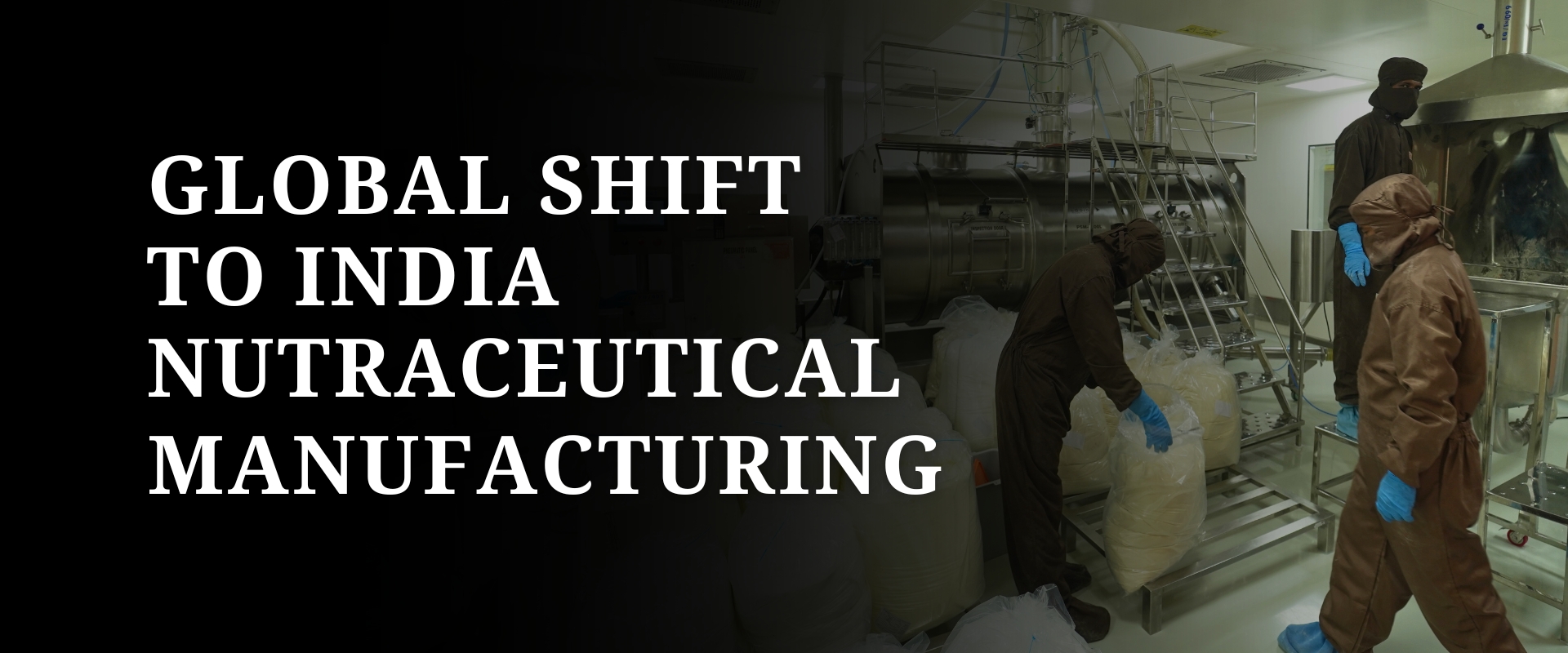
Something structural has changed in how global health brands think about production.
For years, the decision of where to manufacture came down to a familiar set of trade-offs — cost versus control, speed versus quality, proximity versus scale. India sat comfortably on one side of that equation. It was the affordable option. Reliable enough. Good for generics.
That framing no longer holds. The brands and entrepreneurs now approaching Indian manufacturers are not choosing India despite their quality standards — they are choosing India because of them. The shift is real, and the reasons behind it are worth understanding clearly.
The era of relying on a single, centralized manufacturing hub is over. The “China Plus One” strategy has gained undeniable momentum, accelerated by geopolitical pressures and rising concerns around supply chain concentration. For brands that had historically sourced from a single geography, the fragility of that model became impossible to ignore.
India was the obvious beneficiary — not by default, but because it had spent two decades quietly building the infrastructure to absorb that demand. India currently hosts over 650 USFDA-compliant manufacturing plants, the highest count outside the United States. That isn’t a coincidence. It reflects a systematic investment in regulatory alignment that now gives brands entering or scaling in India a genuinely defensible compliance position from day one.
The conversation has moved. Indian firms are no longer simply exporting raw materials — they are exporting intellectual property in the form of proprietary ingredients, clinical data, and differentiated delivery systems. For a brand evaluating nutraceutical supplements manufacturing partners, this distinction matters commercially. A manufacturer with genuine formulation depth can be a growth lever. One that only executes instructions is a cost line.
The outsourcing relationships that define the current landscape increasingly resemble co-creation rather than simple delegation — and Indian CDMOs have responded with end-to-end services spanning early formulation through commercial scale-up. This is not the language that applied to Indian manufacturing a decade ago. It reflects a genuine capability shift that brands building differentiated supplement lines can now access.
India’s formulation strength is not purely infrastructural. India offers more than manufacturing capability — the depth of its botanical expertise, combined with growing clinical validation of traditional ingredients, is creating a distinct class of differentiated formulations that other manufacturing geographies cannot easily replicate.
Ashwagandha, curcumin, amla, shilajit — these are not exotic inputs requiring complex import logistics for an Indian facility. They are domestic commodities with established supply chains, traceable sourcing, and decades of processing knowledge behind them. For brands building clean-label or Ayurveda-aligned supplement lines, this proximity to source is a structural advantage that translates directly into ingredient quality, traceability, and cost stability.
Ten years ago, regulatory compliance was a checkbox exercise for many Indian manufacturers. Today, it is a competitive weapon. The US FDA and EMA have intensified scrutiny of overseas manufacturing, and India’s leading facilities have responded with robust quality frameworks, digital documentation, and proactive transparency.
For a brand with export ambitions — whether to the US, EU, Middle East, or Southeast Asia — the certification architecture of your manufacturing partner determines your market access. A facility carrying USFDA registration alongside certifications like BRCGS, NSF GMP, or FSSC is not simply ticking boxes. It is providing your brand with the documented quality infrastructure that regulators and retail buyers increasingly require before a product reaches a shelf.
There is an important distinction worth making here. Not every Indian manufacturer offering production services operates as a CDMO. A Contract Development and Manufacturing Organisation is engaged from the formulation stage — bringing scientific capability, regulatory knowledge, and production systems together under one roof. For brands that don’t carry large in-house R&D teams, this model compresses the timeline from concept to market significantly.
The Indian CDMO market is projected to grow from $22.5 billion in 2024 to nearly $44.6 billion by 2029, at a CAGR of 14.6% — driven by the recognition among global brands that the right Indian partner is a strategic asset, not a transactional vendor.
This is the context in which brands should be evaluating their options. When considering a global cdmo manufacturing company for a supplement line — whether a first launch or an expansion — the facility’s scientific infrastructure, regulatory standing, and formulation capability matter as much as its unit economics.
H&H invested ₹310 Cr in one of Asia’s largest nutraceutical and herbal plants, spanning 15 acres, with USFDA registration and certifications including BRCGS, NSF GMP, FSSC, SEDEX, and FSSAI — covering tablets, capsules, powders, and softgels across healthcare and cosmetics.
For brands that have done their homework on what a serious manufacturing partner looks like in 2026, H&H represents exactly what the current moment in Indian production has produced: scale, compliance, and formulation science operating under the same roof.
The shift to India isn’t a trend. It’s a structural realignment — and for brands building for the long term, the time to be part of it is now.
Partner with excellence. Launch your branded supplements today.

India’s trusted CDMO Partner, delivering science-driven solutions across healthcare & cosmetics sectors.
© 2026 H&H Healthcare and Cosmetics Pvt. Ltd. Designed by ROI Makers.