The global wellness economy does not move in straight lines. It moves in cycles of awareness, demand, and supply readiness. Right now, India sits at a point where all three are converging simultaneously, and the manufacturing side of this equation is doing some of the most consequential work happening anywhere in the health industry.
India’s nutraceutical market was valued at USD 8 billion in 2024 and is projected to reach USD 21.48 billion by 2033, growing at a CAGR of 11.60%. What is notable here is not just the size but the composition. Among source categories, the plant-based segment emerged as the dominant force in 2024 and is poised to maintain its leadership position through 2030, driven by the rich reservoir of bioactive compounds that botanical sources offer and India’s deep cultural alignment with plant-derived health systems.
This is not a cyclical wellness trend. It is a structural realignment in how consumers across age groups and income levels approach health. The dietary supplements segment is projected to experience strong growth from 2025 to 2033, fuelled by rising health consciousness, a growing middle-class population, and increased awareness about preventive care.
Brands are no longer satisfied with off-the-shelf formulations repacked under their label. They want precise ingredient combinations targeting defined health outcomes, supported by stability data and third-party verification. Bioavailability is another expectation. A botanical extract delivering only a fraction of its active compounds to the bloodstream is, clinically speaking, not very different from an inert product.
Asia-Pacific regions are seeing 25 to 30 percent annual growth in vegan and plant-derived nutraceuticals, with consumers moving beyond the “vegan” label and focusing instead on functionality, bioavailability, and clean-label integrity. Meeting that expectation requires manufacturing partners who have actually invested in the science, not just the machinery.
India’s position in this market is not accidental. Its rich heritage, the availability of botanical raw materials, and a strong presence as a preferred supplier in export markets make it a formidable contender globally. Ashwagandha, turmeric, brahmi, moringa, tulsi — these are not imported ingredients requiring complex supply chains. They grow across Indian geography, which means shorter lead times, better traceability from farm to finished product, and cost structures that are genuinely competitive internationally.
But raw material access alone has never been the differentiator. Serious manufacturers now run HPLC-verified standardization, validated extraction protocols, and multi-stage quality checks that confirm active compound concentrations from incoming raw material all the way through to final output. This is what a herbal extract supplement CDMO operation at the premium end of the market looks like today. Not batch-and-ship, but science-led, documentation-heavy, internationally certifiable production.
FSSAI registration is a baseline. What separates export-ready operations is the additional certification stack: USFDA registration, BRCGS food safety certification, NSF GMP, FSSC 22000, SEDEX compliance. For manufacturers pursuing international partners, compliance extends well beyond domestic requirements, with United States Pharmacopeia monographs defining standardization methods for numerous botanical extracts.
For brands looking to enter the US, EU, or Southeast Asian markets, the certification profile of their manufacturing partner is not a box-checking exercise. It is the foundation of their market access strategy.
Within India, the central region has quietly become one of the more consequential hubs for large-scale production. Madhya Pradesh, specifically the Indore corridor, benefits from proximity to botanical raw material sources, established logistics infrastructure, and manufacturing capital that has flowed in significantly over recent years.
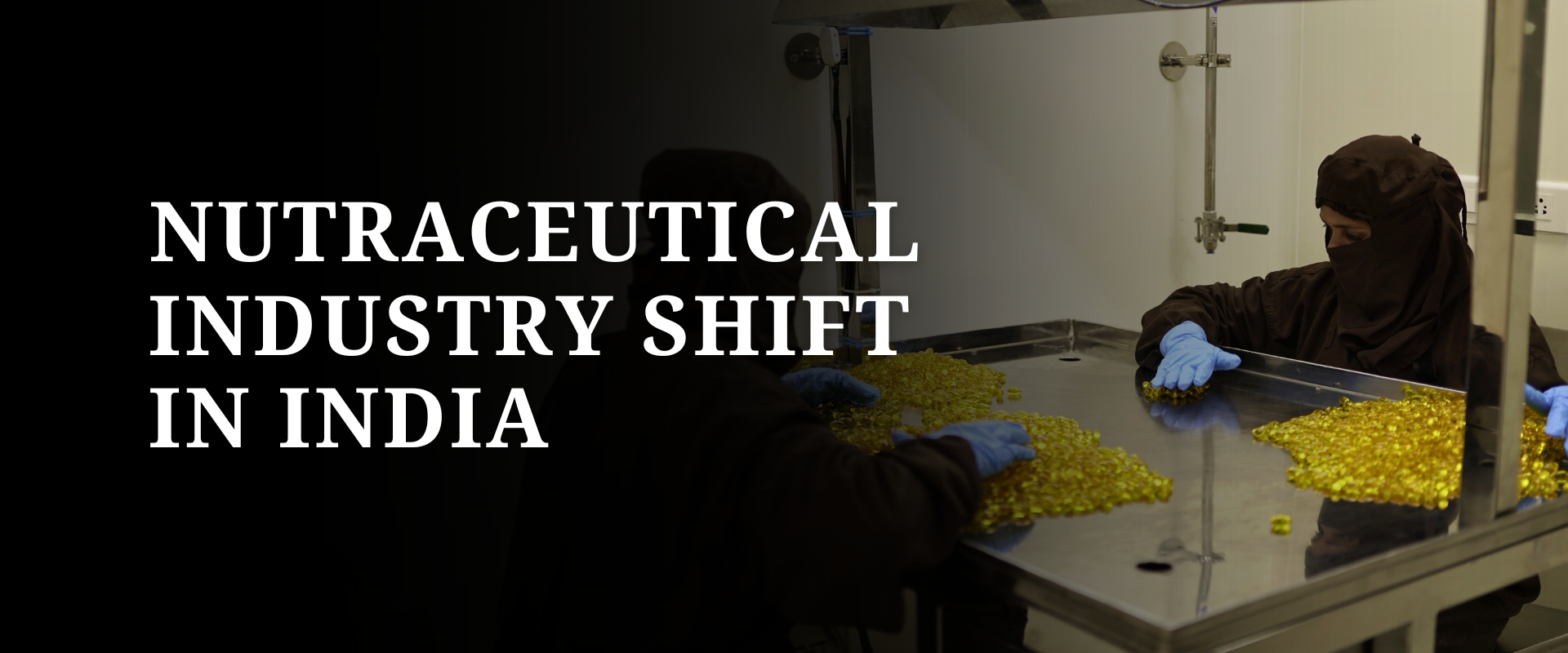
H&H Healthcare and Cosmetics, based in Indore, is among the clearer examples of that investment thesis in action. H&H invested ₹310 crore in one of Asia’s largest herbal and nutraceutical plants, spanning 15 acres and holding USFDA registration, as well as BRCGS, NSF GMP, FSSC, SEDEX, and FSSAI certifications. That scale and certification profile matter for brands that need to move from pilot batch to commercial volume without making the manufacturer’s capacity their bottleneck.
Evidence-based botanicals dominated industry conversations through early 2026, with clinically-backed ingredients including Bacopa, Berberine, and botanical extracts taking prominence alongside next-generation probiotics and yeast-derived proteins. The direction is clear: clinical validation, sustainable sourcing, and formulation sophistication are no longer premium positioning strategies. They are table stakes for any brand targeting informed consumers or regulated export markets.
India’s manufacturing ecosystem is not just keeping pace with this. In several areas, it is setting the terms.
For brands still treating manufacturing as a cost centre rather than a capability centre, the next few years will be instructive. The ones that build serious partnerships with producers who invest in science, documentation, and genuine quality infrastructure will find the market considerably more accessible than those who do not.
The infrastructure exists. The regulatory frameworks are maturing. The botanical raw material base is unmatched. What remains is the judgment to use all of it well.
H&H Healthcare and Cosmetics Pvt. Ltd. is a USFDA-registered, multi-certified nutraceutical and herbal manufacturer based in Indore, Madhya Pradesh. With a 15-acre facility and end-to-end capabilities spanning formulation, manufacturing, private labeling, and global export compliance, H&H partners with wellness brands looking to bring serious products to serious markets.
Partner with excellence. Launch your branded supplements today.

India’s trusted CDMO Partner, delivering science-driven solutions across healthcare & cosmetics sectors.
© 2026 H&H Healthcare and Cosmetics Pvt. Ltd. Designed by ROI Makers.