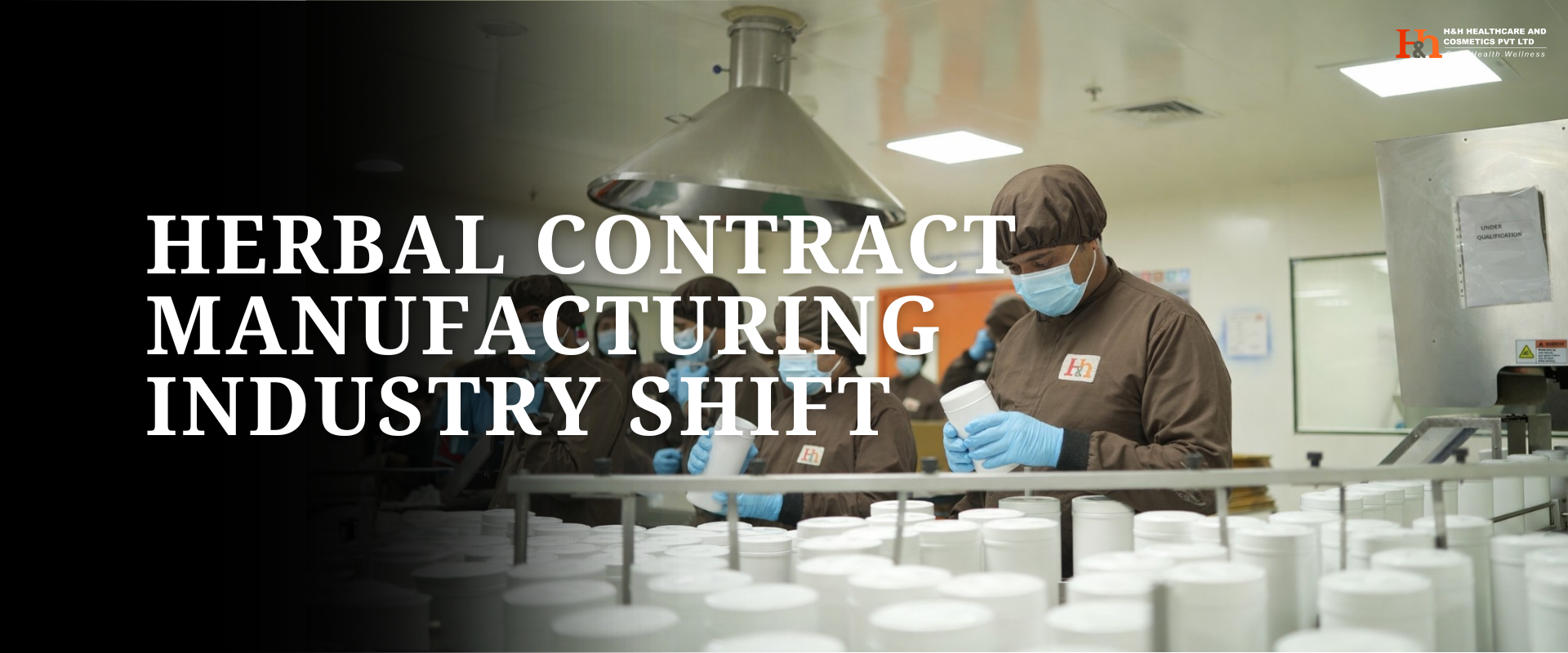
Somewhere between ancient botanical knowledge and modern quality science, a quiet but significant shift is taking shape across India’s wellness industry. Brands that once treated herbal formulations as secondary product lines are now building entire portfolios around them — and the infrastructure supporting this shift is herbal contract manufacturing.
This is not a trend born from consumer curiosity alone. It is backed by structural demand. The global herbal medicine market, valued at USD 251 billion in 2025, is projected to reach USD 515 billion by 2034, growing at a steady 8.37% CAGR. Within India, dietary supplements — the segment most closely tied to botanical and plant-based formulations — account for roughly 40% of the domestic herbal products market. These numbers reflect a consumer base that has moved well beyond novelty purchases into deliberate, repeat health decisions.
For brands navigating this space, the central question is no longer whether to invest in herbal product lines. It is how to build them correctly, at the right speed, and with the scientific credibility that modern consumers now expect.
Herbal formulations carry a complexity that synthetic products typically do not. Plant-based raw materials are inherently variable — potency shifts with season, geography, and extraction method. A standardised finished product requires precise quality controls at every stage: sourcing, extraction, formulation, and stability testing. Without that discipline, even a well-intentioned product fails to deliver what its label promises.
This is the practical reason why herbal contract manufacturing hnh has become the preferred route for brands looking to scale without compromise. Rather than building an in-house production unit — which demands significant capital, regulatory navigation, and years of operational learning — brands partner with established CDMOs (Contract Development and Manufacturing Organisations) that already have that infrastructure in place.
The right manufacturing partner brings more than machinery. It brings formulation expertise, validated quality systems, and regulatory alignment across multiple frameworks — GMP compliance, FSSAI standards, and AYUSH protocols where applicable. For brands with export ambitions, this alignment extends to US FDA and EU market requirements as well.
India’s contract manufacturing sector is growing at a 14.43% CAGR and is expected to reach USD 57.94 billion by 2031. Much of this growth is concentrated in pharmaceuticals, but the herbal and nutraceutical segment is gaining ground rapidly — driven by demand from domestic wellness brands, Ayurvedic companies, and international buyers seeking cost-efficient yet quality-assured manufacturing partners.
The country holds structural advantages that few other markets can replicate. A deep biodiversity base, centuries of documented botanical usage, a growing scientific workforce, and an expanding regulatory framework that now actively supports traditional medicine validation — together, these create conditions where herbal manufacturing can operate at both scale and standard.
Within this ecosystem, brands looking for a credible manufacturing partner need to look beyond basic GMP certification. The evaluation criteria should include the facility’s formulation R&D capability, the range of dosage forms it supports, its traceability systems for raw materials, and its track record with finished product stability.
H&H Healthcare and Cosmetics Pvt. Ltd., based in Indore, Madhya Pradesh, operates at the intersection of herbal science and modern manufacturing discipline. The facility has been built with an investment of over INR 310 crore and is among the largest dedicated nutraceutical and herbal manufacturing plants in Asia.
What distinguishes H&H within the CDMO space is its emphasis on bioavailability — ensuring that the active compounds in any herbal formulation are delivered in a form the body can actually absorb and use. A product that is technically accurate in its ingredient composition but ineffective in delivery is not a finished product; it is an incomplete one. H&H’s formulation approach accounts for this gap systematically.
The facility supports a wide range of dosage forms — capsules, softgels, tablets, effervescents, and powder blends — giving brand partners the flexibility to develop product lines that suit their target consumers. And because H&H operates in alignment with international regulatory standards, brands manufacturing here are positioned for both domestic retail and global export from the same production environment.
The clearest beneficiaries of this manufacturing model are wellness startups building their first product lines, established FMCG brands expanding into the nutraceutical space, and international brands seeking India-based production for cost and supply chain reasons.
In each case, the value of a capable herbal product contract manufacturing is the same: it compresses the time between a validated product idea and a market-ready, regulation-compliant formulation — without asking the brand to become a manufacturing company in the process.
India’s herbal wellness market is growing. The question worth asking now is which brands will build on a foundation strong enough to grow with it.
Partner with excellence. Launch your branded supplements today.

India’s trusted CDMO Partner, delivering science-driven solutions across healthcare & cosmetics sectors.
© 2026 H&H Healthcare and Cosmetics Pvt. Ltd. Designed by ROI Makers.