The supplement aisle — whether physical or digital — has never been more crowded. Immunity blends, adaptogen stacks, collagen powders, and probiotic capsules compete for the same consumer attention across the same channels, often with near-identical ingredient lists and indistinguishable packaging. In this environment, the question every brand founder eventually confronts is the same: what actually makes one supplement brand worth choosing over another?
The answer, more often than founders expect, originates not in marketing but in manufacturing. Specifically, whether the product was built from genuine formulation science or assembled from whatever a catalogue offered at the lowest available minimum order quantity.
Those are not the same thing. And the market is getting better at telling them apart.
India’s nutraceutical sector crossed USD 8.93 billion in 2025 and is tracking toward USD 23 billion by 2034. That growth is real, but it has also attracted a volume of new entrants that has compressed margins, accelerated category noise, and raised the bar for what a credible product needs to demonstrate. Consumers in the wellness space are increasingly informed — they read labels, cross-reference claims, and make repeat purchase decisions based on outcomes rather than packaging.
For brands building in this environment, product differentiation is not a marketing question first. It is a formulation question. A product built around a specific health objective — with ingredients selected for bioavailability, dosage forms chosen for the target demographic, and stability validated across the product’s intended shelf life — behaves differently in the market than one assembled from standard templates. It holds up under scrutiny. It earns repeat purchases. It builds the kind of brand equity that paid marketing can amplify but cannot manufacture on its own.
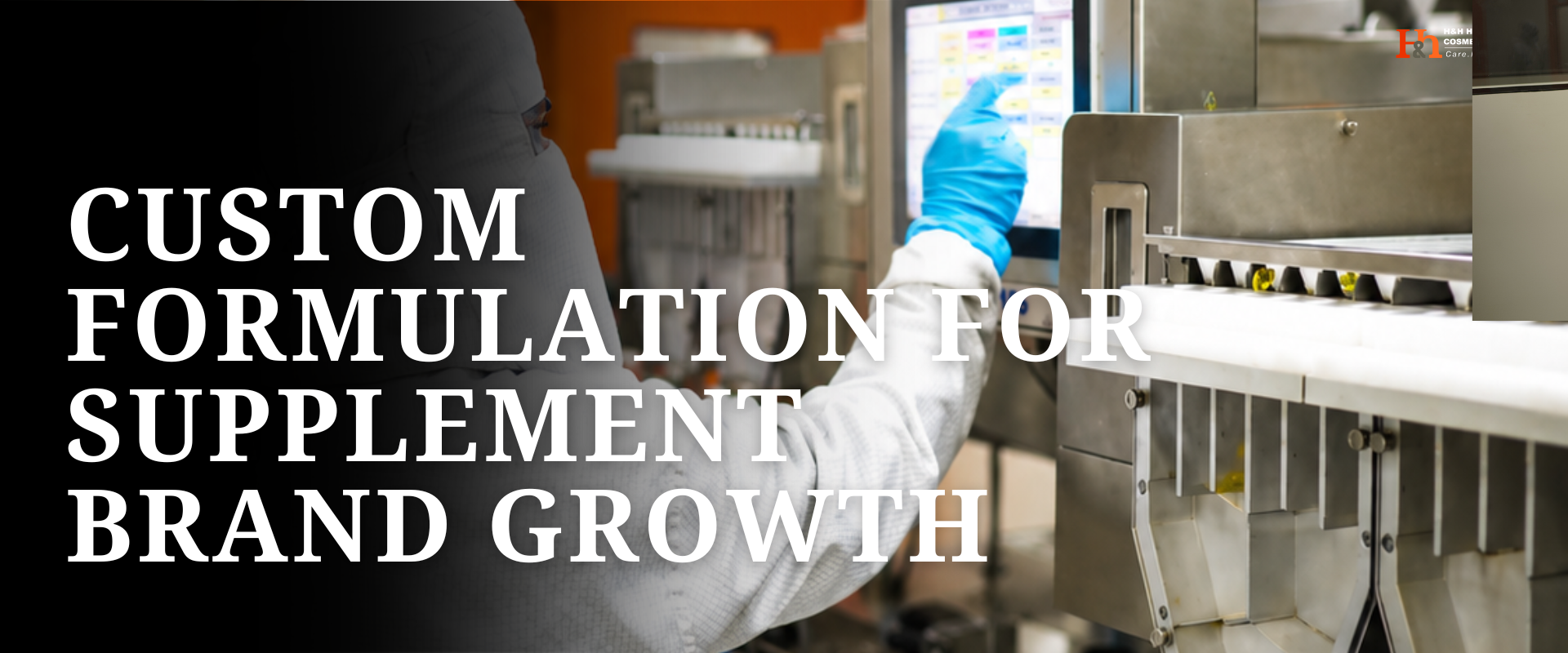
This is where the relationship with a custom formulation supplement manufacturer becomes a strategic asset rather than a production arrangement. The distinction matters because not every manufacturing partner offers the same depth of involvement. Some execute formulations handed to them with precision and care. Others participate in the development process — contributing ingredient knowledge, advising on format suitability, flagging interaction risks before they become production problems, and helping substantiate health claims with documented formulation rationale.
For brands entering categories where the science is nuanced — cognitive health, metabolic support, hormonal balance, or sports recovery — the latter model is not a premium option. It is the baseline requirement for building a product that does what it claims to do.
The infrastructure question deserves equal attention. A manufacturing facility’s automation levels, production line diversity, and quality documentation systems are not background details. They determine whether the product a consumer receives in batch 47 is identical to the one they first purchased in batch three. Consistency is the invisible attribute that drives retention — and it is almost entirely a function of manufacturing process maturity, not brand intent.
Regulatory standing adds another dimension that brands frequently underestimate at the outset. For domestic market compliance, FSSAI certification and proper labelling frameworks are non-negotiable. For brands with any export ambition — whether to Gulf markets, Southeast Asia, or Western economies — the manufacturer’s certification portfolio determines access. A facility registered with the USFDA and carrying BRCGS or NSF GMP credentials removes regulatory friction that would otherwise surface at exactly the wrong moment.
The private label supplement manufacturing at its most commercially effective is not a shortcut to market — it is a strategic model that allows brands to focus resources on the activities where they have a genuine competitive advantage: market positioning, consumer education, distribution, and brand building. The manufacturing partner handles formulation development, production execution, quality assurance, and regulatory documentation. The brand captures the value of that expertise without replicating the infrastructure investment that makes it possible.
What separates the brands that scale from those that stagnate is typically how seriously they treat the manufacturing partnership from the beginning. Brands that evaluate partners on price per unit alone tend to encounter the consequences of that decision between twelve and eighteen months after launch — when quality inconsistencies emerge, regulatory questions surface, or a scaling conversation reveals that the manufacturing facility cannot absorb the volume growth without compromising the standards the brand has built its reputation on.
The Indian manufacturing landscape has matured to a point where world-class formulation science, regulatory-grade facility infrastructure, and genuine product development collaboration are available to brands of meaningful scale. The selection challenge is not finding a manufacturer — it is identifying the partner whose depth of capability matches the ambition of what the brand is trying to build.
Conclusion
Supplement brands are ultimately product businesses. The marketing, the community, and the distribution matter — but they are multipliers applied to whatever the product itself delivers. Getting the formulation and the manufacturing partnership right at the foundation is not the most visible investment a brand makes. It is, however, the one that determines whether everything built on top of it holds.
Partner with excellence. Launch your branded supplements today.

India’s trusted CDMO Partner, delivering science-driven solutions across healthcare & cosmetics sectors.
© 2026 H&H Healthcare and Cosmetics Pvt. Ltd. Designed by ROI Makers.