The healthcare and wellness industry runs on trust. Consumers trust the brand on the label. Brands trust the manufacturer behind the formula. That chain of trust is only as strong as the weakest operational link — and for most product companies, the weakest link is not the idea, the marketing, or the distribution. It is the manufacturing. Finding a partner who can carry a product from a formulation brief all the way to a client warehouse, without dropping quality, compliance, or timelines, is one of the most consequential supply chain decisions a brand will make.
For years, the contract manufacturing industry in India operated in fragments. A brand would work with one partner for formulation development, another for regulatory documentation, a third for production, and yet another for packaging and dispatch. Each handoff was a potential failure point. Each vendor relationship required management bandwidth. And every delay at one stage cascaded into the next.
The integrated CDMO model was built to solve exactly this problem. A full-service contract drug manufacturing cdmo takes ownership of the entire product lifecycle — from the first formulation conversation in the lab to the final pallet dispatched to the client’s warehouse. There are no internal handoffs that become the client’s problem. There is one partner, one point of accountability, and one standard of quality applied from beginning to end.
H&H Healthcare and Cosmetics Private Limited is built precisely on this philosophy. Its hnh nutraceutical contract manufacturing services cover the full operational arc — from science to dispatch — so that a client never has to manage what happens in between. That is H&H’s responsibility, and the systems, people, and infrastructure in place are designed to carry it without exception.
Every product begins with a brief. A brand arrives with a concept — a target efficacy, a delivery format, a regulatory category, a cost envelope. What happens next determines whether that concept becomes a viable, scalable, market-ready product or a protracted development cycle that burns time and capital.
H&H’s in-house formulation and development capability means that the science and the scale-up thinking happen in the same room. Formulators who understand both the chemistry and the commercial reality of production create formulations that are not just technically sound but practically manufacturable across batch sizes, raw material variables, and regulatory requirements.
This matters more than most brand leaders initially appreciate. A formula that performs well in a pilot batch but behaves inconsistently at production scale creates enormous downstream problems. Quality deviations, batch failures, and regulatory queries all trace back, more often than not, to formulations that were not developed with production reality in mind.
The formulation stage is where differentiation begins. The depth of capability here — across nutraceuticals, pharmaceuticals, and cosmetics — means that a brand does not have to arrive with a finished formula. It can arrive with a category intent and a target consumer, and the development process builds from there.
Between a validated formula and a production batch sits an entire layer of regulatory and documentation work that is invisible to the consumer but critical to the brand. This includes stability testing, safety assessments, ingredient compliance across target markets, labelling regulations, and the full suite of drug manufacturing compliance requirements for pharmaceutical categories.
A capable manufacturing partner does not treat this stage as a checkbox exercise. Regulatory rigor is embedded into the formulation and production process from the beginning, not appended at the end. This is the difference between a partner that helps a brand avoid problems and one that discovers them after a batch has already been produced.
H&H’s compliance posture is built around this principle. Documentation, quality control protocols, and regulatory readiness are integrated into how every product is developed and manufactured. When a client needs to demonstrate compliance to a buyer, an auditor, or a regulatory authority, the documentation is already in order.
This is where operational infrastructure becomes the story. Running a single production line for a handful of SKUs is a fundamentally different challenge from managing eight lines simultaneously across 100 or more products, each with its own formulation, packaging specification, batch size, and delivery timeline.
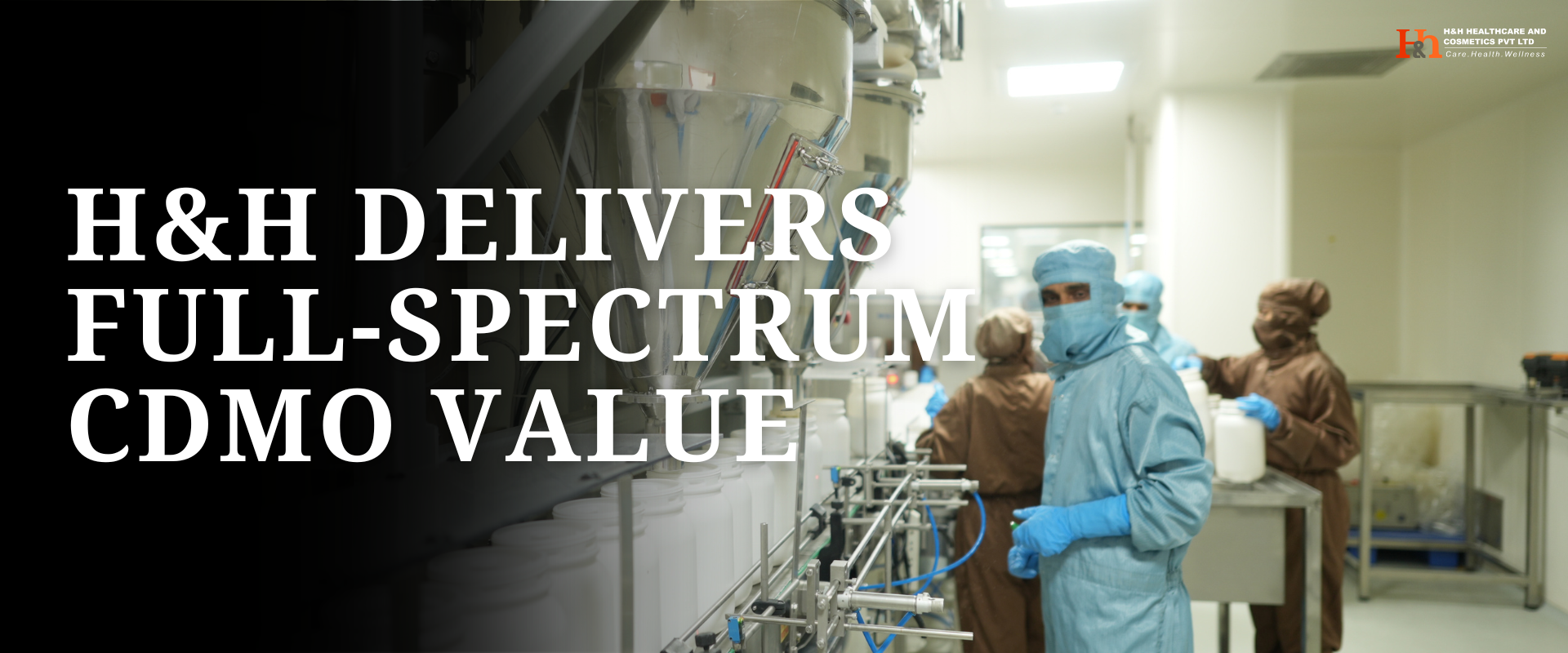
H&H’s production infrastructure has been built and expanded precisely for this kind of complexity. The growth from limited line availability to eight fully operational lines is not simply a capacity story. It is an organizational capability story. Each additional line requires scheduling precision, raw material coordination, quality checkpoints, and workforce alignment. Managing this at scale, across a diverse product portfolio, is what separates a factory from a true manufacturing partner.
For brands that are growing, this scalability is a prerequisite, not a preference. A manufacturing partner that cannot grow alongside a brand’s volume requirements forces a painful and expensive transition at exactly the moment when operational stability matters most. H&H’s active investment in further expansion and greenfield development means that client relationships are not constrained by the manufacturer’s ceiling.
The organization also runs operations on holidays when client timelines demand it. This is not a policy statement. It reflects how the business treats client commitments — as fixed, not flexible.
The final stage of the manufacturing journey is where many manufacturing organizations reveal operational gaps they managed to conceal earlier in the process. Packaging errors, labelling inconsistencies, quality release delays, and dispatch coordination failures are common and consequential — because they affect what actually reaches the market.
H&H’s OTIF — On Time In Full — commitment governs this entire final stage. Product that leaves the facility has cleared quality release, is correctly packaged and labelled, and is dispatched to the client’s warehouse on the committed date. The end-to-end process is measured against this standard without exception.
For a business leader evaluating manufacturing partners, OTIF is one of the most reliable indicators of operational maturity. It is easy to claim. It is difficult to sustain across a high-volume, multi-SKU production environment. Holding this standard consistently across a portfolio of over 100 products reflects how deeply the operating discipline runs through the entire organization.
The implications of partnering with a full-service manufacturing organization extend well beyond the immediate benefit of managing fewer vendors. They reach into strategic territory.
When formulation, production, compliance, and delivery are handled by a single accountable partner, a brand’s internal team is freed to focus on what it does best — building consumer relationships, strengthening distribution, and developing the next product generation. The manufacturing function becomes a source of competitive advantage rather than a persistent operational concern.
This is particularly relevant for mid-market wellness, nutraceutical, and pharmaceutical brands scaling rapidly without the capital or organizational capacity to build manufacturing infrastructure in-house. For these businesses, outsourcing to an integrated partner means accessing enterprise-grade manufacturing capability without the capital commitment, regulatory burden, or overhead that comes with owning a factory.
It is equally relevant for larger pharmaceutical and consumer health companies rationalizing their manufacturing footprint. Outsourcing specialized categories to a capable partner allows these organizations to reduce fixed costs, increase operational flexibility, and focus internal resources where they create the most value.
Manufacturing outcomes do not happen in isolation from organizational leadership. The quality of a CDMO’s output is a direct function of the caliber of the people running it — their operational experience, their systems thinking, and their willingness to treat client outcomes as personal accountability.
H&H’s operational leadership brings decades of experience from large-format FMCG and healthcare organizations — environments where operational discipline is not optional and where the consequences of execution gaps are immediate and visible. This experience, applied to a fast-growing contract manufacturing business, has accelerated the organization’s trajectory in ways that capital investment alone cannot replicate.
For a C-suite leader evaluating manufacturing partners, this dimension deserves serious attention. Certifications and installed capacity are table stakes. The quality of operational thinking running the factory is what determines whether a partnership holds its promise over time, across volume, and across the complexity of a growing product portfolio.
A product is only as good as the process that produces it. In nutraceutical and pharmaceutical manufacturing, where quality, compliance, and consistency are non-negotiable, the choice of manufacturing partner shapes everything that follows. H&H Healthcare and Cosmetics offers a model that removes fragmentation, closes accountability gaps, and eliminates the execution risk that comes with managing multiple vendors across a complex supply chain. From the first formulation conversation to the final delivery, the standard stays constant. That consistency is not a marketing position. It is an operational reality built one production line, one product, and one on-time delivery at a time.
Partner with excellence. Launch your branded supplements today.

India’s trusted CDMO Partner, delivering science-driven solutions across healthcare & cosmetics sectors.
© 2026 H&H Healthcare and Cosmetics Pvt. Ltd. Designed by ROI Makers.