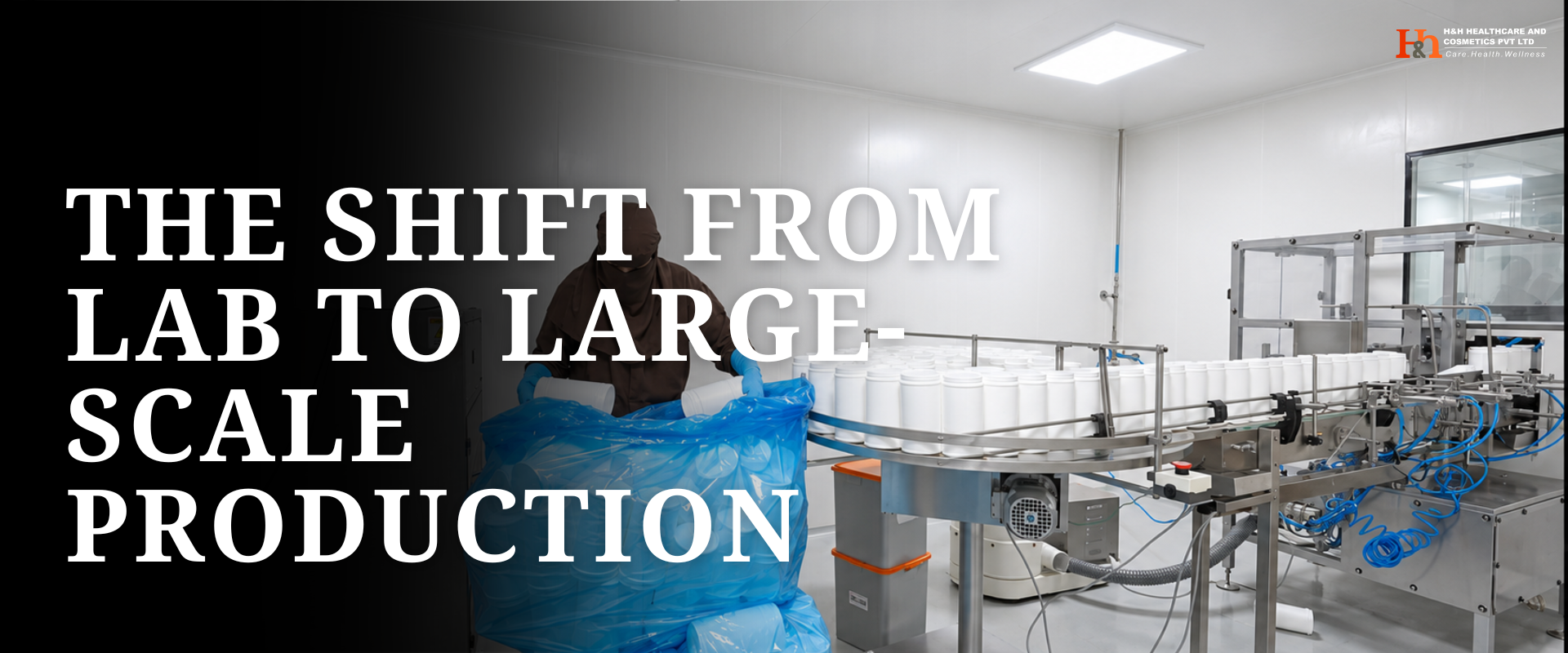
A formulation that performs well in a laboratory does not automatically behave the same way when produced in commercial quantities.
Small-scale trials are valuable for evaluating ingredient compatibility and early product characteristics. However, increasing batch size introduces changes in equipment, material movement, processing time, and environmental exposure.
This transition is known as scale-up, and it is a critical stage of product development.
Laboratory equipment often operates with relatively small quantities of material.
Commercial manufacturing may involve larger mixers, different filling systems, longer transfer paths, and greater production volumes.
These changes can influence blend uniformity, powder flow, heat transfer, and processing efficiency.
For private label nutraceutical manufacturers, successful scale-up requires understanding which process parameters are critical to maintaining the intended quality of the finished product.
Simply multiplying the ingredient quantities is rarely sufficient.
A blend that appears uniform after a few minutes in a laboratory mixer may require a different mixing approach in commercial equipment.
The geometry of the vessel, mixing speed, fill level, and physical properties of the ingredients can all influence the result.
Overmixing may also create problems in certain formulations, including segregation or changes in particle behaviour.
Manufacturers therefore need to establish suitable mixing conditions rather than assuming that longer mixing always produces better uniformity.
Powder flow, bulk density, compressibility, and sensitivity to moisture can significantly affect production.
An ingredient that is easy to handle manually may present challenges when transferred through larger equipment or filled at higher speeds.
Variations in particle size or density may contribute to segregation during handling.
These issues can affect fill-weight consistency and manufacturing yield.
Pilot-scale batches help reveal such challenges before a full commercial run.
Liquid-filled dosage forms involve their own process considerations.
During the softgel capsule manufacturing process, changes in production scale can affect fill preparation, viscosity management, encapsulation conditions, drying, and handling.
The relationship between fill composition and shell material must remain suitable as production conditions change.
Drying is particularly important because it affects the physical characteristics of the finished capsule. Drying conditions need to be controlled and evaluated for the specific formulation and shell system.
Manufacturers should also assess process consistency, capsule integrity, and relevant finished-product specifications.
Commercial production requires clearly defined procedures, approved specifications, in-process checks, and appropriate quality documentation.
These controls help establish whether a process can repeatedly produce material that meets its intended requirements.
Scale-up studies may lead to adjustments in processing parameters, equipment settings, or even aspects of the formulation.
Such changes should be evaluated and documented rather than introduced without supporting evidence.
Moving from laboratory development to commercial production is not simply a matter of making a larger batch.
It requires a systematic understanding of materials, equipment, process parameters, and quality requirements.
A well-managed scale-up process helps translate a promising laboratory formulation into a consistent, reproducible commercial product.
Partner with excellence. Launch your branded supplements today.

India’s trusted CDMO Partner, delivering science-driven solutions across healthcare & cosmetics sectors.
© 2026 H&H Healthcare and Cosmetics Pvt. Ltd. Designed by ROI Makers.