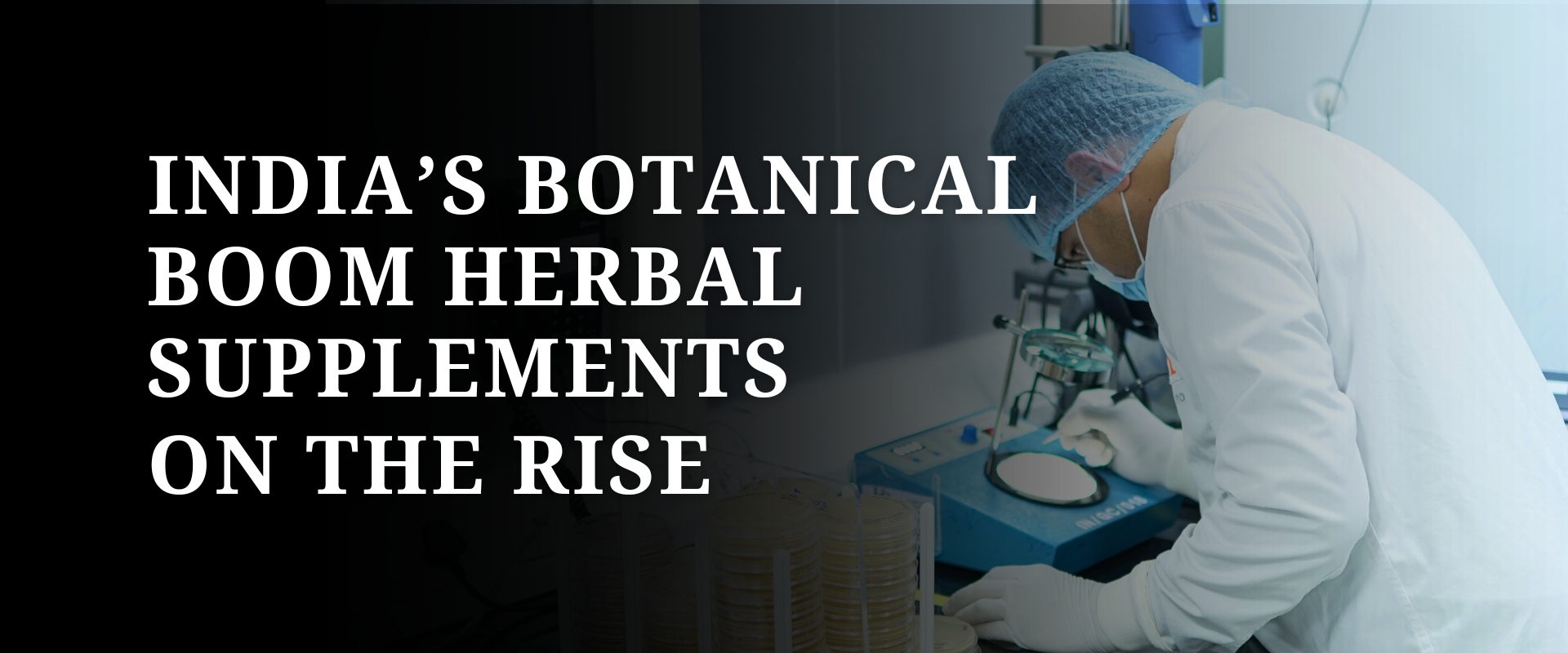
India’s wellness economy is redefining how a nation of 1.4 billion people thinks about health. The Indian nutraceuticals market, valued at approximately USD 8 billion in 2024, is projected to reach USD 21.48 billion by 2033 at a CAGR of 11.60%. That trajectory is not driven by volume alone. It is being shaped by a fundamental change in how Indian consumers approach wellbeing — from reactive treatment to preventive care.
This shift carries real weight for manufacturers, brands, and healthcare partners operating in the space. At the center of it all is a growing demand for products that are scientifically credible, botanically grounded, and built to scale.
India’s chronic disease burden is accelerating. According to the World Health Organization, non-communicable diseases now account for 61% of total mortality in the country. This reality is pushing a growing segment of the population toward nutraceutical-based interventions — not as alternatives to medicine, but as meaningful daily support for immune resilience, metabolic health, and joint function.
Consumers aged 35 to 55 are actively prioritizing preventive care, with strong preferences for herbal and Ayurvedic formulations. Younger urban demographics — millennials and Gen Z — are following suit, drawn to clean-label formats and convenience-driven delivery systems like gummies, effervescent tablets, and sachets.
India’s Ayurvedic tradition has not slowed this demand — it has accelerated it. The cultural familiarity with ingredients like ashwagandha, turmeric, tulsi, and giloy has created a distinct advantage for domestic manufacturers. These are not novel ingredients that require consumer education. They are trusted, recognized, and increasingly backed by clinical science.
Wanting to use herbal ingredients and being equipped to do so at scale are two different things. The complexity runs deeper than blending and encapsulation. Raw material authentication, seasonal variability in active compound concentration, pesticide residue compliance, and GACP (Good Agricultural and Collection Practices) adherence are the operational realities that separate credible manufacturers from the rest.
For a brand building a product around curcumin, ashwagandha extract, or a multi-herb adaptogen complex, inconsistent potency across batches is not just a quality issue — it is a regulatory liability. FSSAI mandates that botanical ingredients meet standardized usage levels, and manufacturers are required to maintain documented scientific evidence for every formulation decision. This is the environment in which a partner’s depth of botanical expertise becomes a genuine commercial differentiator.
The nutraceutical sector’s growth has attracted significant capital, with gross margins in the range of 55 to 65%, making it one of the more profitable areas of India’s health economy. But profitability at scale requires infrastructure that goes well beyond a licensed facility.
Modern supplement production demands automated capsule-filling lines, validated tablet press operations, in-house HPLC and UV spectrophotometry for potency verification, and full batch traceability. For export-oriented brands, WHO-GMP compliance, ISO 22000 certification, and alignment with FDA dietary supplement standards are expected by global buyers across Europe, the Gulf, and North America. India’s pharmaceutical manufacturing heritage provides a meaningful foundation — but only for manufacturers that have actively extended these capabilities into their nutraceutical operations.
As the sector matures, brands at every stage — D2C labels, mid-sized wellness companies, and established pharmaceutical firms diversifying into supplements — are recognizing that formulation expertise is not something to build from scratch. Partnering with a facility that already has it is the more intelligent path.
For a brand working with a capable herbal extract supplement cdmo, the value goes beyond production capacity. It includes formulation science — improving bioavailability of poorly soluble botanical actives, achieving taste masking in complex herbal blends, and designing extended-release matrices. These decisions made at the development stage have a direct impact on product performance and regulatory timelines. Nutraceutical market trends 2026 reflect this logic clearly: mid-sized companies, which represent approximately 44.6% of CDMO demand globally, are increasingly choosing manufacturing partners over in-house expansion.
India’s agroclimatic diversity spans over 52 zones and supports the cultivation of more than 1,700 medicinal plant species. No other market offers the same combination of raw material access, traditional knowledge, scientific talent, and pharmaceutical-grade infrastructure. The government’s Nutra Task Force has set a target of USD 100 billion for the nutraceuticals industry by 2030 — a goal that looks increasingly credible given the sector’s current momentum.
At H&h, nutraceutical manufacturing in India is our core focus. We work across the full spectrum of botanical and supplement formulations, with processes designed to meet FSSAI, WHO-GMP, and international quality standards. Our infrastructure supports brands that are serious about clinical-grade consistency, from raw material sourcing through to finished product release.
The brands and manufacturers that invest in genuine scientific and operational depth today will define what the next generation of wellness products looks like. HnH is here to build that with you.
Partner with excellence. Launch your branded supplements today.

India’s trusted CDMO Partner, delivering science-driven solutions across healthcare & cosmetics sectors.
© 2026 H&H Healthcare and Cosmetics Pvt. Ltd. Designed by ROI Makers.